www.circolovelicoventotene.com
Founded in 1985, the Ventotene Sailing Club has been a member of the F.I.V. (Italian Sailing Federation) since 1986, thus becoming an FIV Authorized Sailing School and registered in the National Register of Amateur Sports Associations affiliated with CONI.
The Ventotene Sailing Club is also an FIV Nautical Training Center registered with the Port Authority of Rome. From its earliest years, the Ventotene Sailing Club, in addition to its regular summer sailing school—has offered training to students during their participation in school camps on the island of Ventotene.
This experience gave rise to the “Sailing with School” project, which contributed to the definition of the national “Sailing School” project, the subject of an agreement between the National Sailing Federation and the Ministry of Education.
Over 70 Italian schools have joined this project to train their students in the sport of sailing. Since 2014, the Circolo Velico Ventotene has been the leading Italian sailing club in terms of number of Junior, Cadet, and Junior and Cadet students. In 2019, it had 1,564 members, making it not only the leading Italian sailing club in terms of Sailing School members, but also the second largest Italian sailing club in terms of total number of members. On November 13, 2015, the Circolo Velico Ventotene signed an agreement with the Lazio Regional School Office “to promote and develop cultural and sporting initiatives related to the sea, environmental education, and sailing for students and teachers in schools of all levels in Lazio.”
In 2014, Circolo Velico Ventotene signed an agreement with the Faculty of Sports Sciences at the University of Rome Tor Vergara to include sailing in the curriculum and to promote refresher courses for teachers and school camps for students.
In 2023, Circolo Velico Ventotene is the leading Italian Sailing School in the Italian Sailing Federation (FIV) by number of members.
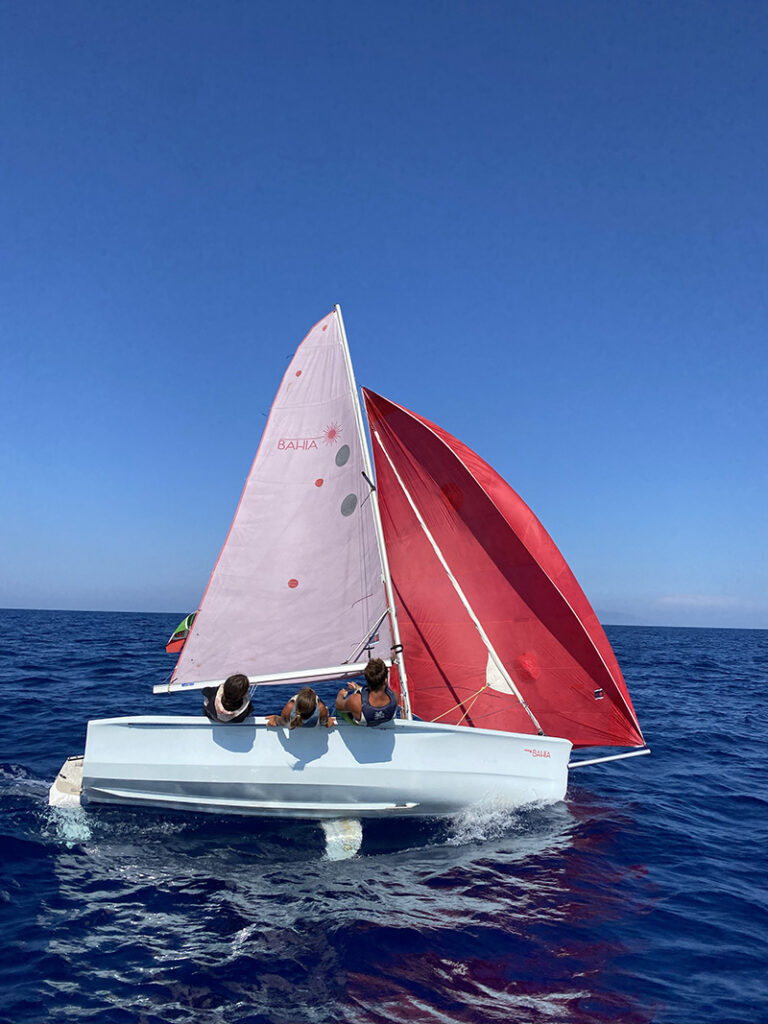
Circolo Velico Ventotene is an accredited and qualified institution of the Ministry of Education pursuant to Directive 170/16
The CVV, in collaboration with Mediterranea Viaggi e Cultura, has also been managed, in agreement with several state schools accredited by the Lazio Region (IT Bianchini of Terracina, Ist. Prof. J. Piaget of Rome, Ist. Prof. Cesi of Rome), training courses: specific professional courses in the Nautical sector for “Nautical Tour Operator”, “Nautical Instructor” and “Skipper” and in the Environmental Education sector for “Nature Guide to Protected Marine Oases and Reserves”. The CVV collaborated in managing training courses in the nautical sector in 1987 and 1990, promoted within the ESF framework for non-EU citizens. In subsequent years, it ran sailing courses and school cruises for young people with social and mental health difficulties with the ISKRA and CAPODARCO cooperatives. In 2013, it organized training courses for sailing instructor trainees for young non-EU citizens belonging to the Città dei Ragazzi association. The club’s sailing training activities, particularly those aimed at young people, have also been carried out in partnership with public and private entities, including the municipalities of Rome, Bologna, Turin, and Florence, the INPS (National Institute of Social Security), the CRAL (Centres for Social Workers) of Enel, Acea, and Banco San Paolo di Torino. Thanks to these agreements and the proposed program, the activities carried out by students during the school camps can be certified as training credits.
The Club’s Sailing School activities are coordinated by FIV-authorized instructors and assistant instructors trained in courses organized by the Club; all staff are coordinated by a Manager, a Level 2 instructor.
The Circolo Velico Ventotene issues all participants in its sailing courses with the FIV FEDERAL SAILING SCHOOL card, for which a specific form must be completed before departure. This type of card has a fixed cost, already included in the offer, and is, by Federation regulations, required to participate in the activities of FIV-affiliated Sailing Schools, which provide theoretical and practical instruction in sailing techniques according to a format established by the Federation. The FEDERAL SAILING SCHOOL card guarantees full accident insurance coverage.
The CVV proposal involves organizing a field trip at the beginning of the school year, primarily for first-year students. They may be accompanied by older students from the same school, who, in the case of upper secondary schools, may also participate in a work-study program. Through the symbolic value of the trip, first-year students will gain a positive and dynamic image of the school that welcomes them. The school offers them the opportunity to get to know each other, discuss their educational plans, plan their entry into the world of work, learn new terminology and language, explore new places, and practice sailing, all while being supported by future teachers. During their stay, students will be engaged in educational, cultural, and sporting activities on the field, as well as an opportunity to get to know and socialize with each other and others. The goal is to create new cultural and knowledge environments for students, laying the foundation for a healthy relationship with nature and the environment in general, and with humanity, especially with a view to promoting sustainable activities. The “Welcome” project can strengthen the new class group, if it was already formed before the trip, or even contribute to its formation, using the trip and joint work as tools for its formation.
The proposal stems from the collaboration between several secondary schools and the CVV. From this experience, the idea was born to further enhance the PCTO Project (FORMERLY SCHOOL-WORK ALTERNATION), which schools offer to students in their first three years of high school, to promote an educational path aimed at acquiring knowledge and skills related to professions in the world of sport, and sailing in particular. Our proposal is to combine the project with a stay at a place of cultural, environmental, and sporting interest, where students can directly participate in a PCTO project to gain knowledge and experience related to the management and operation of a sailing school and a sports association
In 2002, the CVV signed a memorandum of understanding with the Tunisian Sailing Federation for the training of instructors, the exchange of athletes, and the management of sailing regattas. Under this agreement, the CVV has contributed to the training of over 100 Tunisian citizens, including athletes and coaches from the Federation and Tunisian Sailing Clubs. The CVV, in agreement with the Tunisian Sailing Federation, organizes the Carthago Dilecta Est International Regatta
– Tunisie Sailing Week, which has united Italy and Tunisia since 1999. In 2014 and 2017, the CVV organized specific training sessions in Ventotene for Tunisian students on the subject of Italian language and sailing. The “Velando e Parlando Italiano” project was sponsored by the Italian Cultural Institute of Tunis (MAE) and published on the MAE’s Italian language portal.
The “SAILING WITH THE SCHOOL” project has also given rise to a high-level activity reserved for all Sailing School students with particular competitive aptitudes and for the world of sailing in general. The Circolo Velico Ventotene, which for the first 15 years of its existence had not paid particular attention to competitive commitment, when it decided to establish a competitive team, began a process of training and selecting Sailing School students with particular aptitudes to form a competitive team. Over the years, the team has helped young people achieve great results at national, European, and world level. Added to this is the commitment to designing and organizing internationally prestigious competitive events such as the Regatta www.carthagodilectaest.com (Rome Ventotene Cartagine Hammamet), which has become a classic of offshore sailing in the Mediterranean. In September 2025, it organized the third stage of the Italian WASZP Class Championship in Ventotene
The Circolo Velico Ventotene has developed the FREE TO NAVIGARE project. The project chooses the Boat and the Training Activity as a unique, inclusive collective context for integrating and enhancing everyone’s abilities (not disabilities, but rather different abilities – ref. International Classification of Functioning, Disability & Health (ICF)). These activities are integrated throughout all phases, from the design to the construction of the boat and its use, from the conception of the project and teaching materials to the training of students, teachers, and technicians. The project is aimed primarily at schools, all students, with particular attention to those with different abilities, and at collective and welcoming stakeholders such as schools, families, and associations. The project was presented within the Vodafone Call for Proposals “OSO – Ogni Sport Oltre – lo sport, un’opportunità per tutti” (Other Sport – Sport, an Opportunity for All) and is currently being discussed with Enel Italia – Sustainability and Institutional Affairs.
Through the use In the boating program, students acquire the basic knowledge needed to sail a dinghy, mini-offshore, or offshore sailing vessel, and explore scientific education topics. The STEAM method = (S = Science – T = Technology – E = Engineering – A = Art and Creativity; M = Mathematics). STEAM is a curriculum based on the idea of educating students through an interdisciplinary approach. It embraces four specific disciplines: science, technology, engineering, art and creativity, and mathematics, with an interdisciplinary and applied approach. Rather than teaching the four subject areas as separate and discrete content, STEAM integrates them into a cohesive learning paradigm, based on real-world applications. The difference between the STEAM approach and traditional teaching of science, technology, mathematics, and the arts is the blended learning environment and the demonstration of how scientific method can be applied to everyday life.
Sailing is an excellent environment for STEAM learning. Every time a child climbs into a sailboat, steers the rudder, or adjusts a sail, they are experimenting. Effective and meaningful lessons. The weather above, the water below, and everything on board can provide concrete, everyday science lessons. Connecting this experiential learning with educational objectives can open a whole new world of learning. Adding or enhancing STEAM to a sailing curriculum can have significant benefits, both philosophically and financially.